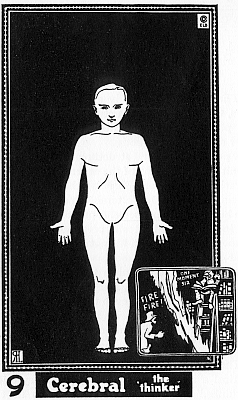
Cerebral
The ThinkerIt is eleven at night and James is still at his desk. He has been working on the same paragraph for two hours and the paragraph is now worse than when he started. He knows this. He is not going to bed. The problem he is trying to put into words is the kind of problem that thinks it is solved, then turns out, on closer reading, to have a small wrong note in it, and he cannot stop hearing the note. His coffee is cold. He does not notice. There is an apple on the corner of the desk that he was going to eat at six. The apple is going to spend the night there.
When his partner comes in to ask whether he is coming to bed, his answer is honest and almost incomprehensible: he says almost, with the air of someone who has not yet noticed that almost is not a time. She has lived with him for nine years. She has seen this before. She does not press.
What the type orients toward
The Cerebral orients toward understanding. They want to know how the thing actually works — not as a goal among others, not as a useful sideline, but as the gravitational centre around which everything else organises itself. Money is not deeply interesting to a Cerebral except as it buys time to think. Status is not deeply interesting except as it widens the range of problems they have access to. Comfort is barely registered. Other people are deeply interesting, but in a particular way: as systems with internal states they would like to model accurately.
In the older constitutional language, this type was the Cerebrotonic, after Sheldon, or the Cerebral after Benedict. The premise was that a person whose nervous system carried the largest share of their constitutional weight would orient toward problems handled by the nervous system, and away from problems handled by the muscles or the gut. The premise has not aged into a scientific theory. The pattern, however, is real and observable, and it survives translation to the contemporary world. It is the person you can identify within ten minutes of meeting them in a working environment: the one whose internal life is louder than the room.
Recognising the type
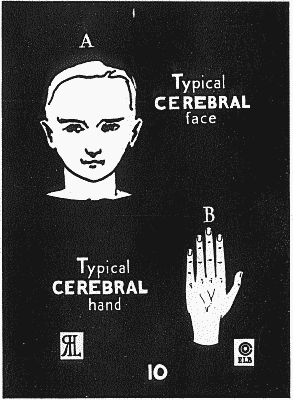
The signal is not intellectualism, exactly. Plenty of types are intellectual; some Muscular operators read more philosophy than the Cerebrals around them. The signal is attention. Watch where a person’s attention goes when they have no instructions. The Cerebral, given an unstructured hour, will reach for something to read, something to write, or a problem to think about. They do this unprompted. They do it when alone. They do it when they should be doing something else.
Linguistic markers. The Cerebral frequently uses qualifying language — roughly, approximately, in general — because they hold themselves to falsifiable claims even in casual speech. They will often refuse to give a confident answer to a question they do not know the answer to, in contexts where other types would simply guess. They use abstract nouns where other types would use concrete ones; they say the issue here is where a Muscular would say the problem is.
Behavioural markers. They are the ones who continue thinking about a conversation hours after it ended. They take notes when no one asked them to. They prefer text to phone calls. They have, somewhere, an unread book they bought four years ago that they still intend to read. They are on time when alone, late when accompanied by Cerebral company, because the company drew them into a problem.
Environmental markers. The Cerebral home tends toward monastic in feel even when it is not in fact spare. Books in stacks. A desk visible from somewhere. A window. Few decorative gestures, but the few are deliberate — a piece of pottery, a small framed print, an instrument they once played. Music, if any, tends to the structured: classical, jazz, ambient, silence.
III · StrengthsWhat the type does well
The Cerebral can sustain attention on problems other types find unbearable. This is the cardinal strength. A problem that requires sitting with the same set of variables for three days, watching them rearrange themselves, refusing to commit to the first plausible answer — that work is a Cerebral. They produce careful original thinking, often by ordinary means. They notice patterns across domains that don’t obviously connect, because they do not stop looking when most people would.
They are honest about the limits of their own knowledge. The Cerebral is the type most likely to say I don’t know when they don’t know, and most likely to mean it. This is not modesty performed for effect; it is a working condition. They cannot do the work they do unless they keep their epistemic accounting clean.
They are tolerant of ambiguity. Where a Muscular wants the decision now and a Circulatory wants the next thing already, the Cerebral can hold a problem in its unresolved state for as long as it takes for the resolution to actually arrive. This makes them excellent at certain kinds of judgement: the long, complicated, multi-variable kind that other types are tempted to short-cut.
IV · VulnerabilitiesWhere the type fails
The same equipment fails in characteristic ways. A Cerebral lives above the neck. Body, food, sleep, exercise — these are noticed when they break, not when they are working. The Cerebral skips meals when absorbed. They sleep poorly because they did not stop thinking before going to bed. They forget to drink water. They are surprised by their own bodies as if the body were a slightly inconvenient roommate.
They over-revise decisions. Where the Muscular’s vice is closing too fast, the Cerebral’s is closing too slow. New information shifts how they feel about a thing they decided yesterday, and they revise. This is intellectual virtue and operational vice. People who work with Cerebrals learn that decided and settled are not synonymous.
They mistake thinking-about-doing for doing. The Cerebral can spend three weeks on the planning phase of a project that needs three days of work and one week of planning. They are aware of this. The awareness does not always help.
They are vulnerable to rumination. Where the Digestive lets things slide off, the Cerebral chews on them. A criticism received in March is still being chewed on in July, in the corners of an otherwise ordinary thought. They re-run conversations to look for what they missed. They do this even when nothing was missed.
Their warmth, where present, can read as aloof to people unaccustomed to it. The Cerebral often loves quietly. They do not always remember to let the loved person know.
V · Vocational fitWhere the type thrives
Research, writing, design, software, law, strategy, anything where the artefact is a model. Long-form writing. Editorial work. Architecture in the broad sense — software, organisational, or building. Roles where the work product is a coherent picture of a difficult thing. Roles where being right matters more than being fast.
They thrive in solo or near-solo work, and in small teams of similar people. They tolerate large organisations badly, except those whose internal culture protects the conditions for thinking — universities at their best, certain research labs, certain firms.
They struggle in roles dominated by repeated transactional contact: high-volume sales, frontline hospitality, bedside healthcare. They struggle in roles that punish slow-cycle thinking. They struggle in roles where the working artefact is the relationship rather than the thing the relationship was for.
VI · Health patternsWhat the body does
Stress lands in the Cerebral’s nervous system before it lands anywhere else. Sleep disruption is the early warning. Disembodiment — the sense of being a brain in a chair, attached to a body it has not consulted recently — is the steady state. The body becomes legible to the Cerebral only when it complains.
Contemporary biology gives some footing here. Polyvagal theory observes that sustained cognitive load runs the autonomic system in a particular configuration that, kept up too long, depletes the system in particular ways. Behavioural genetics finds heritable variance in temperament traits that resemble the constitutional types described here, though the mapping is loose. The gut-brain axis — the bidirectional signalling between intestinal and central nervous systems — is more relevant to Digestive types but matters for the Cerebral too: chronic anxiety expresses through the gut whether or not the anxious person notices.
Practical implications follow from the pattern. Cerebrals are disproportionately helped by physical work that is not their work — gardening, walking, cooking with the radio on. They are helped by structured eating, even when uninspired. They are hurt by indefinite cognitive load without breaks, by stimulants that mask sleep debt, and by the social conventions of the knowledge economy that quietly reward sleep deprivation as a sign of seriousness.
VII · ExamplesA few people who fit
Each of these is a centre of gravity, not a verdict. The framework describes orientations, not identities; people contain more than their type.
- Hannah Arendt — a Cerebral whose work is unmistakably Cerebral in its method: long sustained attention on difficult moral and political problems, careful with categories, slow to close.
- Sherlock Holmes — fictional but useful. The reasoning style, the preference for problems over people, the tolerance of solitude, the impatience with anything that is not a problem.
- George Smiley (le Carré) — the Cerebral as institutional figure. Patient, undeceived, slightly unworldly. Closer to the Skeletal-Cerebral blend than the pure Cerebral.
- A. S. Byatt — the Cerebral as novelist. The novels are themselves long sustained attention on difficult problems.
How the type pairs
The Cerebral’s most productive blends are with the Muscular (the engineer-founder, the applied scientist) and the Circulatory (the public intellectual, the communicating researcher). Both blends solve a problem the pure Cerebral has: they put the thinking into the world.
With the Muscular, the partnership is between question and execution. The Cerebral asks why; the Muscular asks when. Together they ship. The friction is on cycle length: the Cerebral wants more thinking; the Muscular wants the prototype already.
With the Circulatory, the partnership is between depth and audience. The Cerebral has the substance; the Circulatory has the room. Friction lives in pace and tone: the work is slow; the share is fast.
With the Digestive, the blend is unusually gentle when it works. The Digestive remembers the body the Cerebral forgot. Friction at decision-time, when warmth wants harmony and abstraction wants the right answer.
With the Skeletal, the blend produces the institutional thinker — judges, scholars, founders of slow-burning institutions. Friction is rare; when it appears, it is about expression, since both parties prefer reserve to demonstration.
With another Cerebral, partners can build an unusually intricate inner life together. The risk is that neither party feeds the other or remembers to leave the house.
IX · Where the framework breaks downHonest limits for this type in particular
Two cautions specific to the Cerebral. First, intellectualism is not unique to a constitutional type. Many people who are not constitutionally Cerebral are extremely intelligent, deeply curious, and read more than they sleep. The Cerebral describes a centre of gravity — where attention goes when no one is steering — not the entirety of intelligence. Treating the type as the smart type is both wrong and unkind to other types.
Second, the knowledge economy systematically over-rewards Cerebral traits and systematically reads them as virtues. This makes the type desirable in a way that distorts both self-reporting and the reception of test results. People want to be Cerebral the way nineteenth-century people wanted to be aristocratic. The framework gives no special weight to the Cerebral over the others. The Cerebral is a way of being built; it is not better than the alternatives.
The framework as a whole has further limits. See Where this framework breaks down for the honest critique.